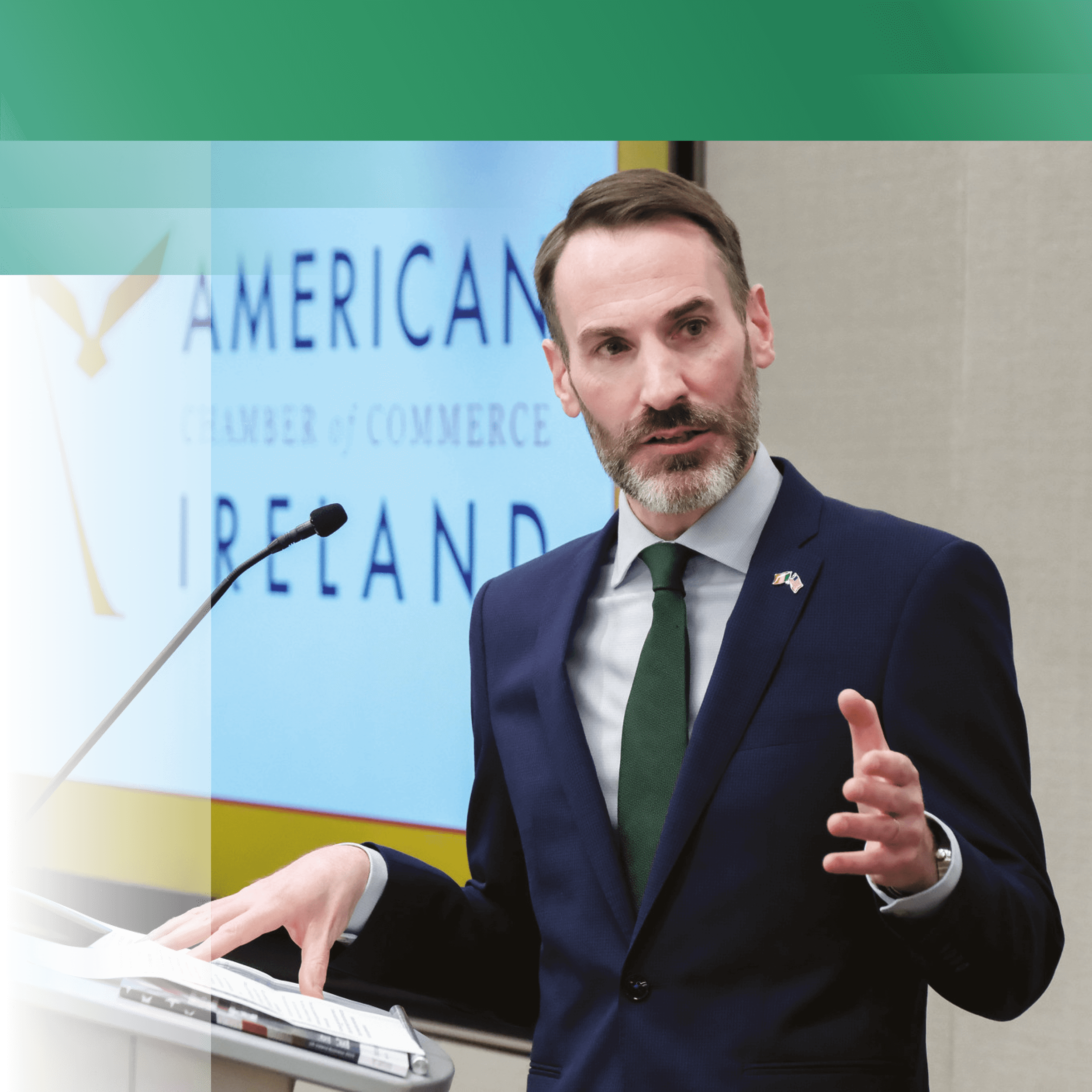
Paul Sweetman

AmCham CEO
Delivery and Competitiveness
in the Next Phase of US–Ireland Growth
The United States and Ireland share one of the most dynamic and deeply embedded economic relationships in the world. Built over decades of trust, investment and collaboration, it is a partnership that has proven to be not only successful, but also enduring, evolving with each new chapter of global growth and innovation.
Today, the US and Ireland are more integrated than at any point in their history. American companies employ approximately 245,000 people in Ireland, while Irish companies employ over 200,000 people across all 50 U.S. states. Ireland is now the fifth largest source of foreign direct investment into the US, with Irish companies having invested close to $390 billion in the US economy. This is not simply a strong trading relationship, it is a deeply embedded, two-way economic partnership that supports high-value jobs, research, innovation and communities on both sides of the Atlantic.
As this year’s US–Ireland Business Report demonstrates, the relationship continues to evolve in line with the industries shaping the global economy, from advanced manufacturing and life sciences to digital transformation and artificial intelligence (A.I.). Companies are investing not only in production and services, but in research, data, automation and talent development. The focus now is not simply on maintaining success, but on ensuring that Ireland and the United States remain at the forefront of innovation and competitiveness in the years ahead.
Across the contributions in this Report, from political leaders, policymakers, enterprise agencies and business representatives, there is a strong consensus on the importance of strengthening competitiveness, reinforcing the Single Market and sustaining an open transatlantic economy. As Ireland prepares for its Presidency of the Council of the European Union, there is a meaningful opportunity to advance that agenda and contribute to a more competitive and coherent European business environment.
From a business perspective, however, competitiveness is not only a matter of strategy, it is more fundamentally a matter of delivery.
Investment decisions in 2026 are being made in an increasingly competitive global landscape. Corporate boards are examining locations through a sharper lens, assessing infrastructure readiness, energy security, talent availability and regulatory certainty alongside the long-standing strengths that have defined Ireland’s offering including access to the EU Single Market, a stable pro-enterprise environment and a highly skilled workforce. Ireland’s fundamentals remain strong and the ambition to strengthen them further is clear. What will be important in continuing to attract US investment is delivering on key business asks with pace and precision.
The positive news is that the intent to invest remains robust. In a recent AmCham survey, nearly 70 percent of member companies indicated plans to invest in Ireland over the next five years, with significant investment earmarked for A.I., automation, digital transformation and workforce upskilling. Companies are deepening their Irish operations, recognising their strategic importance in diversified global supply chains. This further reflects long-term confidence in Ireland’s position as a transatlantic hub.
To support this next phase of growth, three areas will be particularly important.
First, infrastructure and capacity must continue to keep pace with ambition.
Ireland has committed significant multi-annual investment through the National Development Plan and related infrastructure strategies. These commitments are essential to sustaining competitiveness. Housing delivery, transport connectivity and digital infrastructure are not peripheral policy issues, they are core economic enablers consistently highlighted by AmCham members as central to expansion decisions. A growing economy requires certainty around planning timelines, efficient project delivery and visible progress on capacity constraints. Continued focus on implementation will reinforce Ireland’s reputation as a location that matches policy ambition with practical execution.
Second, energy security and resilience has become a board-level consideration across the multinational community with AmCham members consistently identifying grid capacity and connection timelines as critical factors in future investment planning. Ireland’s transition toward renewable energy, particularly offshore wind, presents a significant opportunity to strengthen its ambitions for long-term energy independence. Companies need clarity on grid capacity, connection timelines and the scaling of renewable infrastructure to support continued expansion. With coordinated action between Government, regulators and industry, Ireland can position itself as a leader in advancing energy self-sufficiency to drive industrial competitiveness.
Third, talent remains the foundation of Ireland’s success.
Ireland’s highly educated, adaptable workforce has long been its greatest competitive advantage.
Ireland’s highly educated, adaptable workforce has long been its greatest competitive advantage. Close collaboration between multinational companies, universities and research institutions continues to power high-value research and development across sectors such as technology, life sciences and financial services. Sustained investment in education, apprenticeships and research infrastructure, particularly in digital, engineering and A.I.-related disciplines, will ensure this advantage endures.
At the same time, in a world of global skills competition, access to international talent remains important. Ireland has built a reputation as an open, welcoming location for globally mobile professionals. Maintaining an efficient and predictable system for employment permits and visas will further enhance that reputation and support Ireland’s role as a gateway between the United States and the European Union.
None of these priorities are about short-term fixes. They are about ensuring that Ireland’s structural strengths continue to translate into long-term competitive advantage.
The broader global picture, as outlined in this Report’s economic analysis, reminds us that uncertainty is likely to remain a defining feature of the decade. Divergence in growth rates between the U.S. and Europe, evolving trade policies and shifting geopolitical dynamics will continue to test open economies. In that context, stability, predictability and trusted partnerships become even more valuable.
Ireland’s role as a transatlantic bridge is not symbolic, it is operational. As a committed member of the European Union and a long-standing partner of the United States, Ireland offers American companies a stable platform for accessing the EU Single Market of 450 million consumers, supported by a pro-enterprise environment and a culture of collaboration. At the same time, Irish companies are deeply embedded in the U.S. economy, contributing to innovation and job creation across states and sectors
For AmCham Ireland, our role is clear. We will continue to provide data-driven insights, facilitate collaboration among our members, and engage constructively with policymakers to support competitiveness and long-term growth. The ambition of our member companies, both American and Irish, remains strong. Their continued investment reflects confidence not only in Ireland’s current position, but in its future potential.
The US–Ireland economic relationship has always evolved in response to change. From advanced manufacturing to digital transformation and now to artificial intelligence and sustainable technologies, each chapter has built upon the last. If we continue to focus on delivery, certainty and partnership, the next chapter will be no different.
The foundations are strong. The opportunity is significant. By aligning ambition with execution, Ireland and the United States can continue to deepen a partnership that delivers prosperity, innovation and resilience on both sides of the Atlantic for decades to come.